
Most New York neighborhoods have been renovated into something smoother than they used to be. The East Village keeps resisting. It’s still a place where a 170-year-old ale house shares a block with a Korean tapas counter and a vintage shop that sells clothes by the pound, and where the best thing you’ll find all day is probably a community garden you walked past without noticing.
It’s compact — roughly Houston Street to 14th Street, Bowery to the East River — which makes it one of the few Manhattan neighborhoods you can genuinely do on foot in a day. Here’s how to spend one.
Table of Contents
Start with coffee and something laminated
The neighborhood takes its pastry seriously, and the competition is unusually good.
La Cabra on Second Avenue is the Copenhagen import everyone eventually ends up at, and the cardamom bun deserves the queue. If the line is out the door, Smør Bakery on East 12th does a quieter version of the same Nordic idea, and Librae Bakery over on Cooper Square leans Middle Eastern — pistachio, rose, halva, tahini — with a pistachio croissant that has developed something close to a following.
For something older, Veniero’s has been making cannoli and cheesecake on East 11th Street since 1894, in a room that still looks like it. It’s open late, which makes it equally useful at the other end of the day.
Spend the middle of the day outside
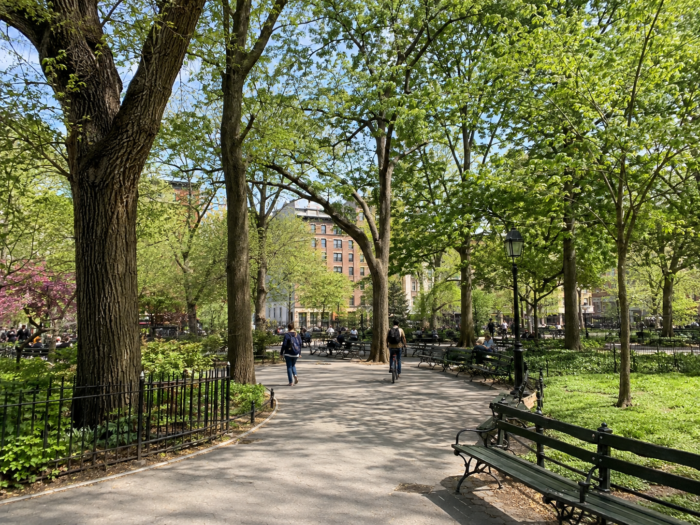
Tompkins Square Park is the neighborhood’s living room. It has a famous dog run, a skate park, chess tables, and a long, complicated history — the 1988 riot here is still a reference point in conversations about how the neighborhood changed. On summer weekends it hosts free concerts and festivals; the rest of the time it’s just the best people-watching in downtown Manhattan.
The better-kept secret is the community gardens. The East Village has dozens, most of them volunteer-run on lots that were derelict in the 1970s, and most open only a few hours a week — which is exactly why they feel like finding a door in a wall.
- 6th Street & Avenue B Community Garden — the most polished of them, with weekend afternoon hours
- 11th Street Community Garden — small, eclectic, and prone to hosting live jazz
- Green Oasis on East 8th — has a koi pond, which in Manhattan feels borderline unreasonable
- Liz Christy Garden on Houston — the original, founded in 1973 and arguably the first community garden in the country
Check hours before you go. Most are closed on weekdays.
Shop the strange stuff
St. Marks Place is the neighborhood’s most famous block and also its most tourist-worn, but it’s still worth the walk — partly for the tattoo parlors and cheap noodle shops, partly for 96–98 St Marks, the tenement building that appears on the cover of Led Zeppelin’s Physical Graffiti.
The vintage scene is the real draw:
- Flamingos Vintage Pound on St. Marks sells by weight, which is either a bargain or a trap depending on your patience
- AuH2O on East 7th is tiny, thoughtfully curated, and genuinely affordable
- East Village Vintage Collective on East 12th spreads over two floors and stocks work by local artists alongside the racks
- Trash and Vaudeville has been outfitting New York’s punks since 1975 and now lives on East 7th Street
- Mr. Throwback on East 9th is a shrine to 90s sports jerseys, run by people who know exactly what they have
Eat
The range here is the point. You can spend $12 or $80 within two blocks.
Veselka on Second Avenue is the neighborhood institution — a Ukrainian diner running since 1954, open absurdly late, and the correct answer for pierogi, borscht, and stuffed cabbage at almost any hour. Soothr on East 13th does northern Thai in a room that stays loud and busy; the khao soi is the order. Thursday Kitchen on East 9th runs Korean small plates with a no-reservations queue and nothing on the menu over about $17. Cafe Mogador has been doing Moroccan on St. Marks for four decades and is still the neighborhood’s default brunch. And Brindle Room on East 11th makes a burger that people travel for.
Drink
McSorley’s Old Ale House on East 7th opened in 1854 and has changed approximately nothing since. Sawdust on the floor, two options — light or dark — and they arrive two mugs at a time whether or not that’s what you had in mind. It’s a tourist stop and a genuine landmark simultaneously, which is rare.
For the other end of the spectrum, the East Village is one of the birthplaces of the modern American cocktail bar. Death & Co on East 6th has been setting the standard since 2006. Amor y Amargo, a few doors down, is a bitters-obsessed shoebox where the bartenders will talk you through amaro for as long as you’ll listen. Please Don’t Tell is still entered through a phone booth inside a hot dog shop on St. Marks, and still requires booking ahead. The Wayland out on East 9th is the loose, low-key one, with live music most nights.
Stay out for the music
The neighborhood’s music history is heavier than its current venue count — CBGB is a clothing store now — but there’s still a real scene.
Berlin is a low-ceilinged basement under Avenue A that books punk and rock for the price of a couple of drinks. DROM, also on Avenue A, programs an eclectic international lineup and is one of the better-sounding small rooms downtown. Webster Hall on East 11th handles the bigger touring acts. And Anthology Film Archives on Second Avenue has been screening avant-garde and restored cinema since the 1970s if you’d rather sit down.
Walk north to where the neighborhood ends
The northern edge — the blocks above 14th Street where the East Village dissolves into Stuyvesant Square and the approach to Gramercy — is quieter, greener, and mostly skipped by visitors.
Stuyvesant Square is the reward: a real public park split by Second Avenue, with mature trees, a Peter Stuyvesant statue, and enough benches to disappear into for an hour. It’s also the consolation prize for Gramercy Park a few blocks northwest, which is famously locked and accessible only to residents holding a key. You can look through the fence. That’s the whole experience.
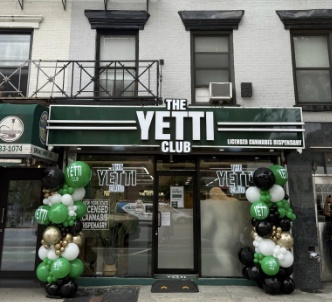
On the way up, at 317 1st Ave, is The Yetti Club — a licensed cannabis dispensary that opened recently on this northern stretch, about a five-minute walk from the 1st Avenue L stop. New York’s legal market has expanded fast, and the newer shops are markedly better than the first wave; this one is a good example of why. The menu is genuinely broad — flower, pre-rolls, vapes, edibles, extracts, infused drinks, tinctures, capsules, topicals — and filterable by type or classification, which matters if you’re browsing rather than restocking. Staff lean toward explaining rather than upselling, which makes it a reasonable stop for anyone who’s curious but hasn’t been inside a legal dispensary before. It’s also pet-friendly, which fits a neighborhood where roughly half the foot traffic has a dog attached.
Getting there and getting around
The L train at 1st Avenue and 14th Street drops you at the neighborhood’s northern edge. The 6 at Astor Place puts you at the western end near Cooper Square, and the F at Second Avenue covers the southern side near Houston. From Union Square, the N, Q, R, W, 4, and 5 are all a short walk away.
Once you’re in, don’t bother with transit. The whole neighborhood is about twelve blocks square, the avenues run A through D toward the river, and the entire point is walking it slowly enough to notice things.