
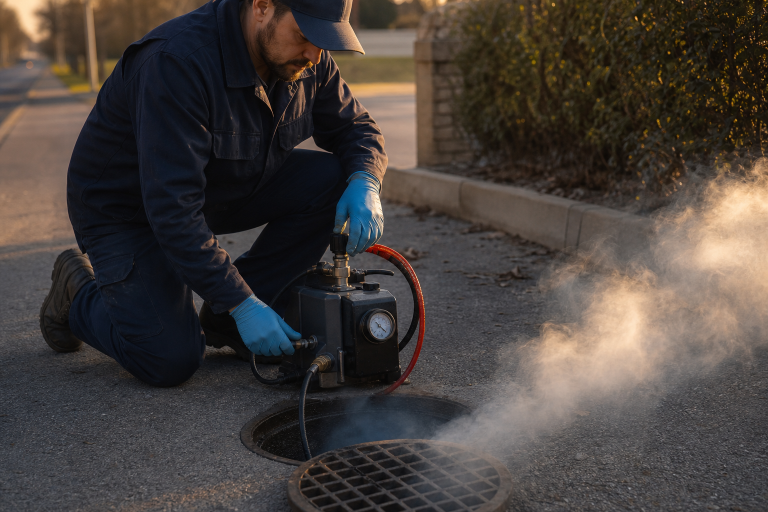
Hidden plumbing leaks, broken sewer laterals, open cleanouts, and improper drainage connections are difficult to diagnose when there is no obvious surface evidence. A smoke pump tester gives crews a practical way to force smoke-filled air through a system and look for the locations where it escapes.
Hurco Technologies, Inc. manufactures the Power Smoker 2 for plumbing and underground inspection work. By creating visible smoke at suspected openings, the equipment can help contractors, municipalities, utility departments, and infrastructure crews narrow a broad problem area into specific locations that need repair or further inspection.
Table of Contents
- 1 Why Are Hidden Plumbing Leaks Hard to Find?
- 2 What Does the Hurco Technologies, Inc. Power Smoker 2 Do?
- 3 How Does Plumbing Smoke Testing Work?
- 4 Where Can Hurco Technologies, Inc. Smoke Testing Help?
- 5 Which Features Matter in the Field?
- 6 What Should a Typical Smoke Testing Process Include?
- 7 What Safety Steps and Limitations Should Crews Consider?
- 8 How Does Smoke Testing Compare With Other Detection Methods?
- 9 Frequently Asked Questions
Why Are Hidden Plumbing Leaks Hard to Find?
Drain and sewer defects can sit beneath slabs, behind walls, under landscaping, or within long underground pipe runs. Cracked laterals, disconnected joints, unsealed cleanouts, and cross-connections may not create an immediate wet spot or visible backup. Even when a property owner reports sewer odor, drainage trouble, or recurring moisture, the true source can remain unclear.
Smoke testing helps by giving air leaks a visible indicator. Smoke escaping from an unintended location can point crews toward a damaged connection, an open drain, or a suspected route between systems. It is particularly useful as an initial investigation tool before excavation or a more time-intensive internal inspection. The EPA includes smoke testing and sewer-camera inspection among collection-system maintenance practices used to reduce inflow, infiltration, and sanitary sewer overflow risks through its collection and lift station maintenance guidance.
What Does the Hurco Technologies, Inc. Power Smoker 2 Do?
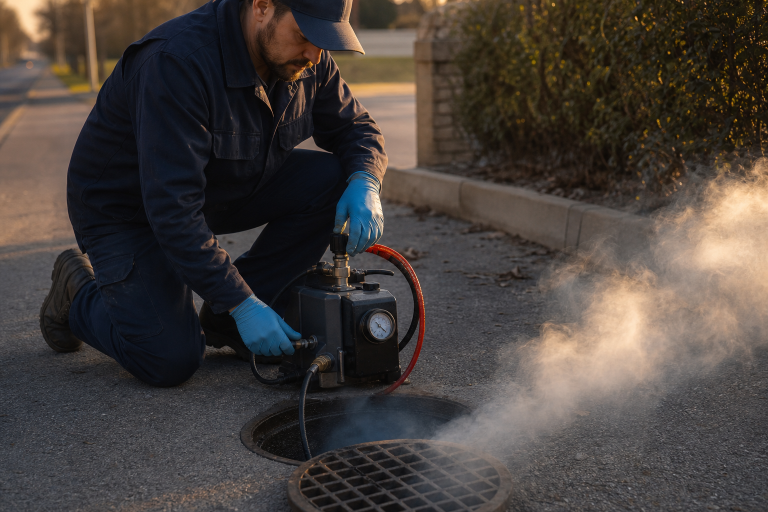
The Power Smoker 2 is a plumbing smoke testing machine that forces smoke-filled air through plumbing systems. Hurco Technologies, Inc. describes it as a cost-effective method for locating leaks and problem areas. Rather than guessing where a defect may be located, crews can observe the path smoke takes through the system and investigate visible escape points.
Published Power Smoker 2 details include a cast aluminum fan rated at 700 CFM at 8.0 inches water gauge. The unit uses Hurco Technologies, Inc. LiquiSmoke, while its SuperJet muffler is designed to provide a higher fluid burn and denser smoke output. Hurco also notes precision-balanced cast aluminum props and states that LiquiSmoke costs cents per minute to use. These details can matter to organizations that need repeatable field equipment and a clear way to estimate consumable use.
How Does Plumbing Smoke Testing Work?
- Define the test section. Identify the drains, cleanouts, manholes, vents, or other access points involved.
- Prepare the area. Use suitable plugs, temporary seals, or barriers to direct smoke through the intended pipe section.
- Introduce smoke. Set up the Power Smoker 2 in a stable position and move smoke-filled air into the system.
- Inspect for escape points. Observers look for smoke at breaks, disconnected laterals, open cleanouts, dry traps, damaged connections, or improper drainage tie-ins.
- Document the evidence. Photograph locations, mark maps, record access points, and note conditions that could affect results.
- Confirm and prioritize. Use other diagnostic methods where necessary to verify the defect, determine severity, and plan repair work.
Where Can Hurco Technologies, Inc. Smoke Testing Help?
Power Smoker 2 testing can support a range of plumbing, utility, and municipal investigations. Common applications include locating concealed plumbing leaks, finding broken or disconnected sewer laterals, identifying open cleanouts, tracing drainage paths, and locating improper connections between sanitary and stormwater systems.
Crews may also use smoke testing to investigate roof leaders, yard drains, area drains, foundation drains, and other sources of unwanted water entering a sanitary system. For recurring sewer odor complaints, smoke can help identify unsealed or damaged plumbing components that deserve closer examination. A smoke pump tester request should explain the suspected problem, pipe sizes, access locations, test area, available power, and field conditions so the equipment can be evaluated for the application.
Which Features Matter in the Field?
- Airflow capacity: The published 700 CFM rating supports moving smoke through plumbing systems with appropriate preparation and isolation.
- Dense smoke output: The SuperJet muffler is intended to increase fluid burn and make smoke easier to observe in suitable conditions.
- LiquiSmoke workflow: Using the manufacturer-specified smoke fluid supports the intended operating process.
- Durable components: Cast aluminum fan and prop construction can be valuable for repeated field deployment.
- Available documentation: Hurco Technologies, Inc. provides product, fire-safety, and operating materials for the Power Smoker 2.
What Should a Typical Smoke Testing Process Include?
Before testing begins, crews should review work orders, utility maps, property conditions, access points, and nearby buildings. Weather, groundwater, pipe flow, and soil conditions can all influence how smoke moves and where it becomes visible. Occupants, property owners, and local emergency contacts should be notified when smoke could appear around buildings or public areas.
During the test, observers should cover the anticipated inspection area, communicate with the equipment operator, and record every smoke location. Afterward, findings should be compared with the mapping and prior inspection records. This creates a more useful repair list than relying on a visual observation alone.
What Safety Steps and Limitations Should Crews Consider?
Follow the Power Smoker 2 operating instructions and fire-safety materials, and use only approved smoke materials for the equipment and application. Keep ignition sources and unauthorized personnel away from the work area. Smoke testing does not eliminate hazards associated with underground infrastructure, building access, traffic, or confined spaces.
Crews should never treat a smoke test as a substitute for confined-space atmospheric monitoring. OSHA’s sewer system entry guidance addresses the need for trained personnel and monitoring for oxygen deficiency, flammable gases, hydrogen sulfide, and carbon monoxide. CCTV, dye testing, pressure testing, or flow monitoring may also be needed when crews must confirm pipe condition, measure leakage, or quantify water entry.
How Does Smoke Testing Compare With Other Detection Methods?
- Hurco Technologies, Inc. smoke testing: Best for quickly revealing visible escape points and likely improper connections. It does not quantify flow or fully show the internal pipe condition.
- CCTV inspection: Best for viewing accessible pipe interiors. It may not identify every external connection or surface-level smoke path.
- Dye testing: Best for confirming suspected drainage routes. It requires water and can involve more setup.
- Pressure testing: Best for determining whether an isolated section holds pressure. It requires controlled test conditions.
- Flow monitoring: Best for measuring water movement and infiltration trends. It does not always identify the exact entry point.
Frequently Asked Questions
What is a smoke pump tester request?
It is an equipment inquiry that describes the intended plumbing or sewer testing application. Include pipe size, access points, approximate test area, suspected defects, power availability, and site conditions.
What can the Power Smoker 2 help detect?
It can help reveal locations where smoke escapes from a plumbing system, including leaks, open cleanouts, broken laterals, disconnected drains, and improper connections. Additional testing may be required to confirm the final diagnosis.
Does smoke testing replace camera inspection?
No. Smoke testing and CCTV inspection answer different questions. Smoke testing identifies visible escape paths, while CCTV can provide internal visual information about accessible pipe sections.