
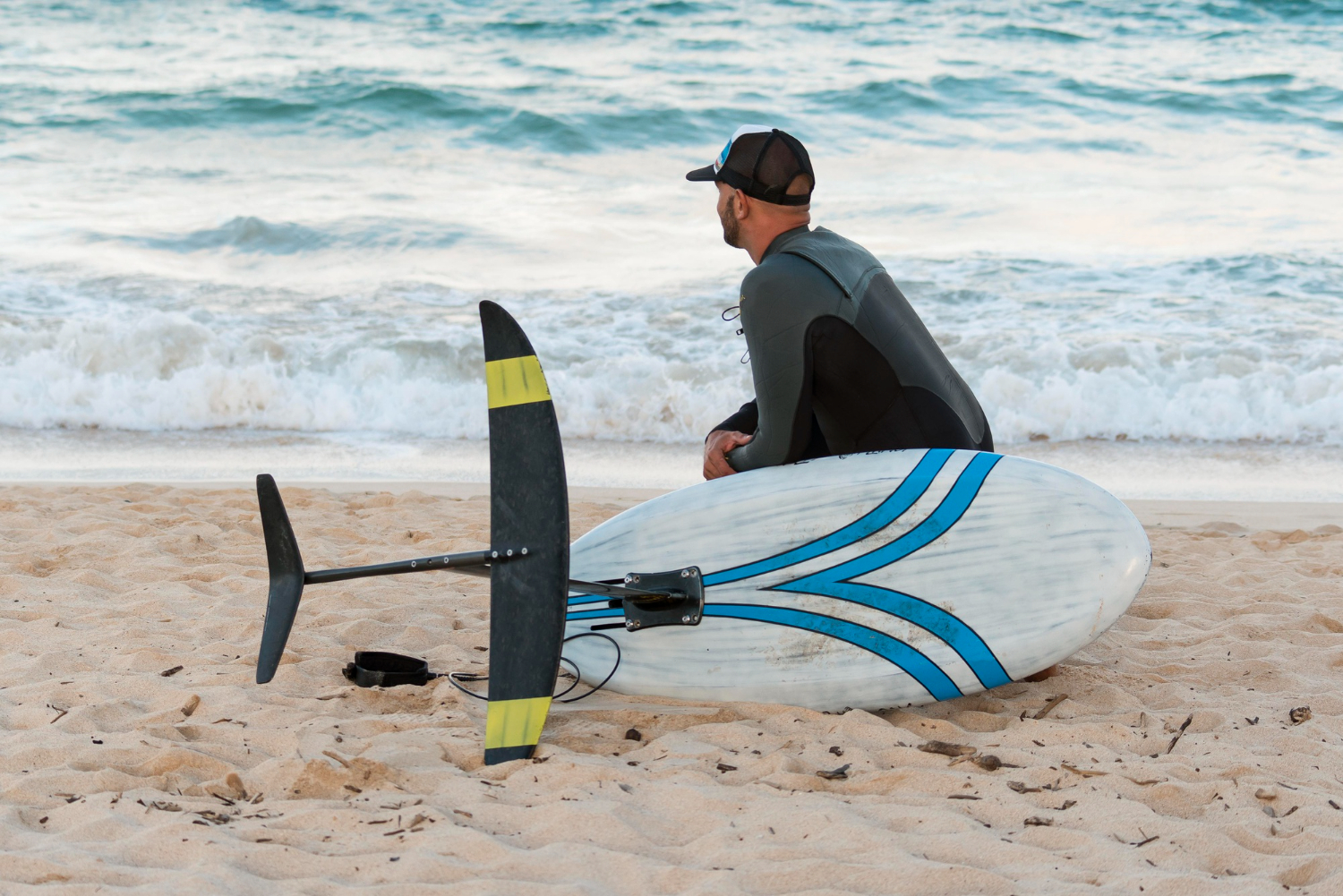
Most people assume the hard part of learning to eFoil is balance. It isn’t. The hard part is getting the board to lift at low speed and stay predictable once it does, and that behaviour is decided by hardware before the rider reaches the water.
Six specifications decide whether a first eFoil feels forgiving or frustrating, and all six appear on any honest spec sheet. What follows is written for a first purchase without a foiling background, so the numbers that govern the learning curve stand out from the ones that sell boards.
Quick answers
- Higher board volume keeps an eFoil stable at the slow speeds where beginners spend their first sessions.
- A larger front wing generates lift earlier, so less throttle is needed to rise onto the foil.
- A shorter mast holds the board closer to the surface, which makes a breach a smaller event.
- A fully shielded jet drive removes the exposed-blade risk during a fall.
- A speed limiter on the remote lets a beginner practise without a surprise acceleration.
A beginner eFoil board is an electric hydrofoil board with high volume, a large low-speed front wing, a short mast and a shielded drive, which together let a rider get up and stay balanced at slow speeds instead of relying on momentum.
On this page
- How much board volume you need
- Why front wing size beats board shape
- Short mast or long mast for learning
- Drive type and its safety systems
- Why throttle control is underrated
- Battery, weight and after-sale support
Table of Contents
- 1 1. How much board volume do you actually need?
- 2 2. Why front wing size matters more than board shape
- 3 3. Short mast or long mast for learning?
- 4 4. Drive type and the safety systems that come with it
- 5 5. Throttle control: the feature list beginners underrate
- 6 6. Battery range, weight and what happens after the sale
- 7 Bringing the six checks together
- 8 Frequently asked questions
- 9 Conclusion
1. How much board volume do you actually need?
Volume and deck area govern stability before the foil produces lift, which is where session one happens. A high-volume board floats a kneeling rider, tolerates shifted weight and stays flat when the throttle comes on. A low-volume board sinks under a stationary rider and only rewards someone who already flies reliably.
Current lineups show the pattern: rigid boards aimed at first flights sit around 100 litres, step-up boards around 80, race boards in the low 70s, and inflatables run from 150 to 230 litres. Heavier riders should read those figures upward. Buy for the first ten sessions, not the fiftieth.
2. Why front wing size matters more than board shape
Lift rises with wing area and with the square of speed, the relationship set out in NASA’s lift equation. For a beginner that means a bigger front wing reaches flying lift at lower speed, so takeoff needs less throttle and the board stays airborne when speed drops mid-turn.
Wing ranges are built along that axis. The largest wing in a range is normally sold for beginners, heavier riders and schools; the smallest for experienced riders chasing top speed. Front wings and stabilisers come as matched sets, and mixing parts across sets changes pitch behaviour in ways a beginner cannot diagnose from the water.
3. Short mast or long mast for learning?
Mast length sets how far the board rides above the water and how much a mistake costs. Two lengths dominate this market: 60 cm and 80 cm. A 60 cm mast keeps the deck close to the surface, so touchdowns are gentle, breaches stay undramatic and shallow launch spots remain usable.
An 80 cm mast buys clearance in chop and allows steeper turns before the wing ventilates, and it asks for more precise weight transfer in return. Masts are sold as spare parts, so a short mast is a starting point rather than a permanent decision.
In short: Volume decides whether early sessions are spent riding or swimming. Front wing area decides how early the board flies. Mast length decides what each mistake costs.
4. Drive type and the safety systems that come with it
Drive type is the highest-stakes item here, because a learner falls next to their own hardware repeatedly. A fully shielded jet drive keeps rotating parts enclosed; an unshielded drive with exposed blades does not, and riding skill does not change that geometry during an unplanned dismount.
Three systems are worth confirming in writing before purchase. Breach or stall protection cuts power when the foil leaves the water, which turns a shootout into a wobble. A kill function stops the drive when the remote loses contact. Automatic shutdown on rider separation keeps a board from motoring away across open water.
5. Throttle control: the feature list beginners underrate
The remote is where a beginner either builds confidence or loses it. Progressive throttle response matters more than peak power, because abrupt input at low speed is what launches riders over the nose.
Four remote features belong on a beginner checklist. A speed limiter caps top speed for early sessions. Selectable riding modes and stepped power levels let the same board grow with the rider. Throttle calibration matches trigger travel to hand size and grip strength, which quietly fixes most jerky-input problems. Reliable pairing and a waterproof rating covering full submersion are non-negotiable.
6. Battery range, weight and what happens after the sale
Advertised ride time assumes efficient flight. Beginners spend much of a session in displacement mode at high throttle, so real session length lands below the rated figure. A second battery solves that more cheaply than a bigger board does.
Total carry weight decides how often the board gets used: complete setups commonly land between 27 and 35 kg across board, battery and foil, and a setup one person can carry alone gets ridden more. Charging safety belongs in the same decision, and the CPSC’s guidance on lithium-ion charging advises using only the manufacturer’s charger and staying present while charging. Spare parts, warranty terms and structured tutorials shape the second month of ownership.
In short: A shielded drive and documented cut-off systems matter more than top speed. A speed limiter and throttle calibration make early sessions teachable. Carry weight and parts availability decide how often the board leaves the garage.
The table below compares a setup chosen for learning with one chosen for progressing, across the five specifications that differ most.
| Specification | Setup for learning | Setup for progressing |
| Board volume | ~100 L and above; inflatables 150–230 L | ~70–90 L |
| Front wing | Largest in range, lift at low speed | Smaller wing, higher top speed |
| Mast length | 60 cm | 80 cm |
| Power setting | Limiter active, lower power levels | Full power range |
| Session length | Below rated, high throttle use | Close to rated ride time |
Bringing the six checks together
The six checks interact. A large wing on a long mast still punishes mistakes; a shielded drive under a 70-litre board still leaves a rider swimming. The practical shortcut is a manufacturer that ships the foil as one configured package rather than as parts to assemble. The eFoil by Aerofoils range, for instance, pairs matched wing sets with a jet drive integrated into the mast, so the combination is set at order rather than by trial and error.
Frequently asked questions
How long does it take to learn to ride an eFoil?
Most riders reach a first flight within a few hours on a high-volume board with a large front wing. Kneeling and standing come first, and stable flight through turns usually takes several sessions more. Setup and water conditions matter more than athletic background.
What size eFoil board should a beginner buy?
A beginner should choose a board of roughly 100 litres or more, and heavier riders should move further up that range. Inflatables between 150 and 230 litres add stability again, which is why schools use them. Boards in the 70 to 90 litre class are step-up equipment, not starting equipment.
Are eFoils safe for beginners?
eFoils are manageable for beginners when the drive is shielded, the board cuts power on breach, and the remote stops the drive if the rider separates from it. A helmet and an impact vest are standard equipment. Distance from swimmers, boats and shallow reef matters as much as any onboard system.
How much does a beginner eFoil cost to run per session?
Running cost per session is essentially one battery recharge, and packs in this class hold roughly one to two kilowatt hours, so the electricity cost stays minor. The recurring costs are wear parts, seals and occasional service. Saltwater use adds a rinse routine that costs time rather than money.
Conclusion
The board that teaches fastest is the one that stays stable slowest. Volume, wing area and mast length decide how early flight becomes possible; drive shielding, throttle control and battery planning decide how safely that learning happens. Before committing, ride the shortlist at a demo or test event.