
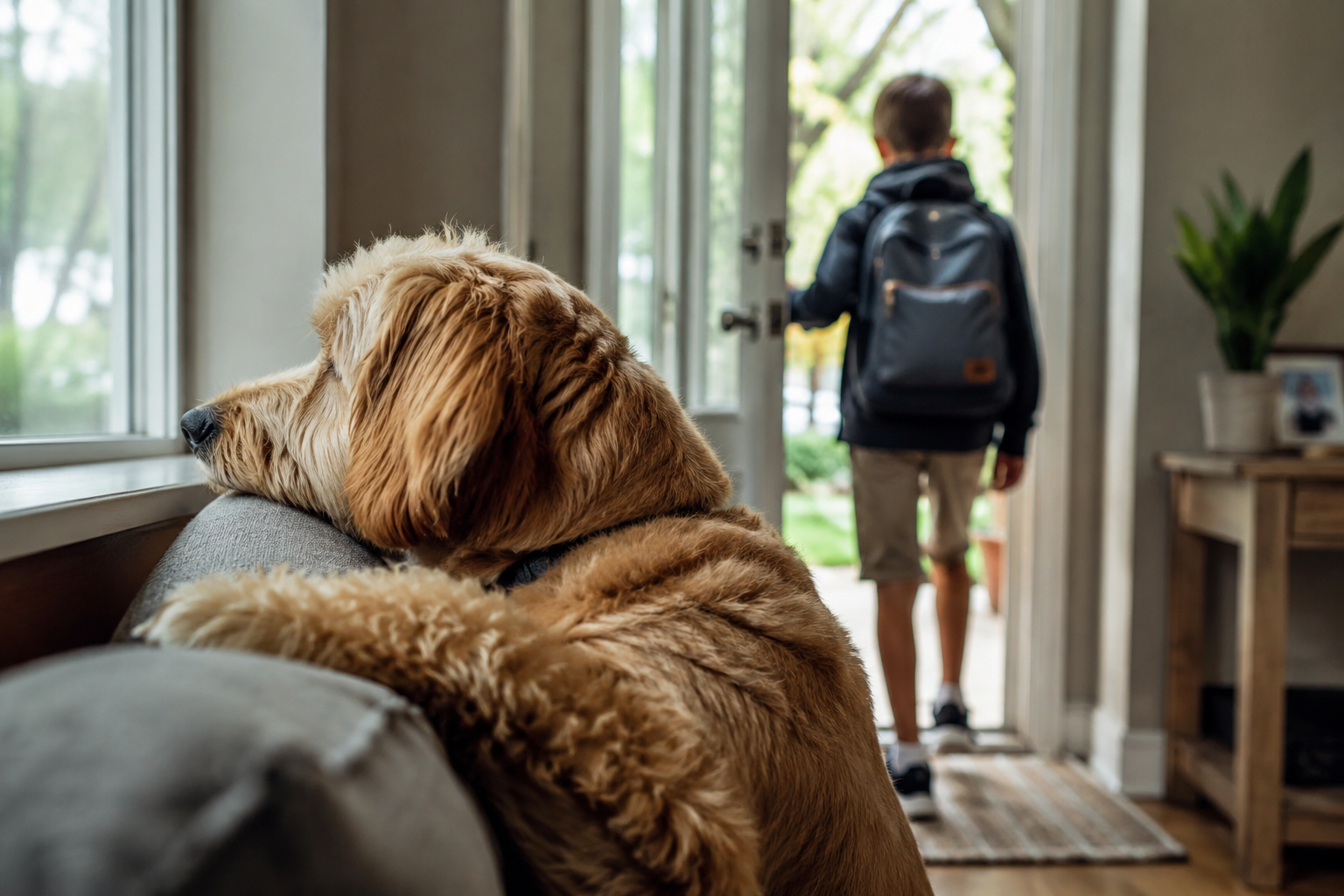
The first day back to school can feel like a major adjustment for the whole household. After weeks of children coming and going, playing in the yard, sharing snacks, and filling the home with noise, the sudden quiet in mid-August can be surprisingly noticeable.
Your dog notices it, too.
Dogs are creatures of routine, and summer often creates a different daily rhythm. When school starts again, those familiar activities can disappear almost overnight. A dog that was accustomed to constant companionship may suddenly spend several hours alone.
That change can lead to restlessness, clinginess, excessive barking, chewing, or other unusual behaviors. Fortunately, there are practical ways to help a dog adjust without making the transition more stressful.
Table of Contents
- 1 Why the Return to School Can Affect Dogs
- 2 Watch for Signs of a Difficult Transition
- 3 Replace Lost Activity With Structure
- 4 Make Alone Time Easier
- 5 Keep Morning Departures Calm
- 6 Do Not Forget the Post-Summer Grooming Routine
- 7 Give Your Dog Quality Time After School
- 8 Avoid These Common Mistakes
- 9 Give Your Dog Time to Adjust
Why the Return to School Can Affect Dogs
Dogs do not understand that the kids are going to school and will return later. They experience a major change in their daily environment.
During summer, children may provide companionship throughout the day. They may play fetch, take the dog outside, or occupy the same room. Once school resumes, those interactions become much less frequent.
The change can affect dogs in several ways:
- Less physical activity during the day
- Fewer opportunities for social interaction
- Changes in feeding or walking schedules
- More time spent alone
- Increased boredom
- Disruption to established household routines
Some dogs adapt quickly, while others need more time. Puppies, highly social dogs, and dogs accustomed to being around people throughout the day may have a particularly difficult adjustment.
Watch for Signs of a Difficult Transition
A little extra attention during the first few weeks can help you identify whether your dog is struggling.
Common signs include:
Increased Clinginess
Your dog may suddenly follow family members from room to room, demand more attention, or become unsettled when someone prepares to leave.
Destructive Behavior
Chewing furniture, shoes, doors, or household items can be a response to boredom or frustration. It may also indicate that your dog needs more mental stimulation during the day.
Excessive Barking
A dog that becomes vocal after the family leaves may be reacting to the sudden absence of familiar people.
Restlessness
Pacing, repeatedly moving from room to room, or struggling to settle can suggest that your dog’s routine has changed too quickly.
These behaviors should not automatically be treated as disobedience. Understanding what may be causing them makes it easier to respond appropriately.
Replace Lost Activity With Structure
One of the best ways to make the transition easier is to create a predictable daytime routine.
If the kids used to spend hours playing with the dog, try replacing some of that activity with scheduled exercise and enrichment. A morning walk before school can help your dog start the day with physical activity. A puzzle feeder or treat-based toy can provide mental stimulation after everyone leaves.
For families that need more daytime interaction, structured care can also help fill the gap. Regular visits to a doggie daycare in Ashburn can give social dogs opportunities for supervised play, movement, and interaction while the household is quiet.
The key is consistency. Dogs often respond well when they can anticipate what happens next.
Make Alone Time Easier
If your dog will be spending more time alone, avoid making the transition happen all at once whenever possible.
Before school starts, gradually introduce periods when everyone leaves the house. Start with short intervals and increase them over time. This allows your dog to learn that people leaving is a normal part of the routine and that they eventually return.
You can also create a comfortable area where your dog can relax. Depending on the dog’s preferences, this might include a bed, a familiar blanket, a safe chew toy, or a food puzzle.
Avoid leaving anything that could be easily destroyed or swallowed.
Keep Morning Departures Calm
A chaotic morning can make the transition harder.
If everyone is rushing to get dressed, pack lunches, find shoes, and leave at the same time, your dog may become excited or anxious from the activity. Keeping the morning routine as predictable as possible can help.
Try these simple changes:
- Take your dog for a short walk before the morning rush.
- Feed breakfast at a consistent time.
- Give your dog a familiar enrichment activity before leaving.
- Avoid dramatic goodbyes.
- Keep departure cues calm and routine.
The goal is not to ignore your dog. It is to make departures feel ordinary rather than emotionally significant.
Do Not Forget the Post-Summer Grooming Routine
The return to school also provides a good opportunity to check your dog’s overall grooming needs. Summer activities can leave behind more than tired paws.
Dogs that spend time outdoors may accumulate dirt, grass, dust, and debris in their coats. Swimming can also contribute to tangled or matted fur, while hot weather may increase shedding.
A thorough grooming routine can help remove buildup and keep the coat manageable as the season changes.
For dogs that become nervous about unfamiliar environments, mobile dog grooming in Herndon can provide a convenient alternative by bringing professional grooming directly to the home. This can be especially useful when a busy back-to-school schedule makes a separate trip to the salon difficult.
Regular brushing at home is still important between professional appointments. Check areas that are especially prone to tangles, including behind the ears, around the legs, under the collar, and near the tail.
Give Your Dog Quality Time After School
When the children return home, it can be tempting to return to the busy summer routine immediately. Instead, make the afternoon or evening a predictable opportunity for connection.
A short walk, game of fetch, training session, or quiet time together can help your dog adjust to the new schedule.
Children can also participate in simple activities that provide mental stimulation. Practicing basic commands, hiding treats for the dog to find, or playing a supervised game can turn a few minutes of family time into meaningful enrichment.
Quality matters more than simply being in the same room.
Avoid These Common Mistakes
A few well-intentioned responses can actually make it worse.
Do not punish destructive behavior after the fact. Your dog is unlikely to connect a later punishment with something it did hours earlier.
Do not suddenly eliminate all activities. If summer involves long walks, frequent play, and social interaction, then replacing all of that with a quiet house can be a major change.
Do not constantly change the schedule. Consistency helps dogs understand what to expect.
Do not overlook boredom. A dog may need more than physical exercise. Sniffing games, food puzzles, training, and supervised social interaction can provide valuable mental stimulation.
Give Your Dog Time to Adjust
The return to school is a household transition, and dogs may need time to understand the new routine. A quieter home does not have to mean an unhappy dog.
By combining consistent schedules, appropriate exercise, mental enrichment, social opportunities, and regular grooming, families can make the change much easier.
Most importantly, pay attention to your dog’s behavior. A sudden change may be temporary, but persistent anxiety, destructive behavior, or other concerning symptoms may warrant guidance from a veterinarian or qualified behavior professional.
With a little planning, the back-to-school season can become a comfortable new routine for everyone, including the four-legged family member who definitely noticed when the house suddenly became much quieter.