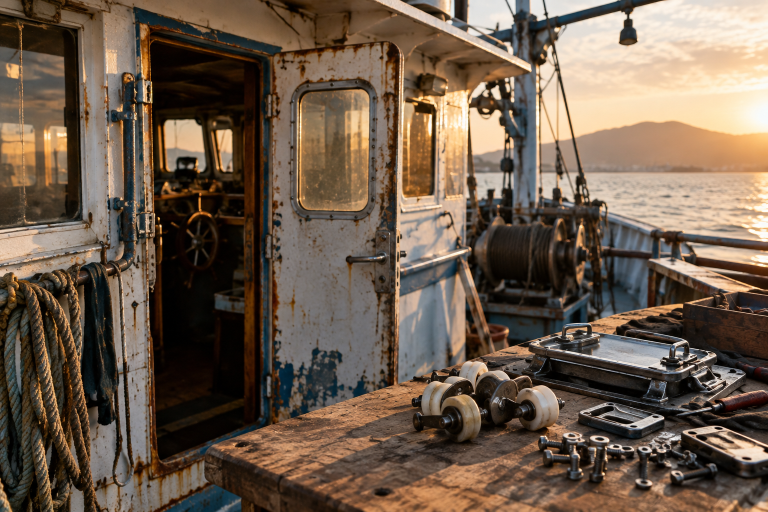
When a hatch riser cracks, a pilot-house door roller seizes, or an original switch fails, the repair can become much harder than it first appears. Owners of older Taiwan-built trawlers often need to match a part that has been modified, weathered, or discontinued. MMI Marine gives owners a focused place to source hard to find replacement hardware marine fittings and hatch risers for classic Taiwan trawlers without starting from a generic search result.
The goal is not simply to find a part that looks similar. A successful replacement should suit the existing opening, mounting pattern, operating environment, material requirements, and, where applicable, electrical or load specifications. Clear information about the vessel and the failed component gives MMI Marine a stronger starting point for helping identify an appropriate replacement or alternative.
Why Classic Trawler Parts Are Difficult to Find
A classic trawler can have decades of repair history behind it. Previous owners, yards, and technicians may have changed latches, hinges, pumps, switches, portlight trim, deck fittings, or door hardware. As a result, the component now installed may not be the one fitted when the boat left the builder.
Even a seemingly straightforward part can have details that determine whether it fits. Hatch hardware may depend on a specific riser height or hole pattern. A door roller may require a specific wheel diameter, axle size, track profile, and load capacity. A switch must match the circuit voltage, terminal configuration, current demand, and intended marine environment. Those differences explain why a photo alone is helpful but rarely sufficient.
How MMI Marine Can Help
MMI Marine is relevant when the request involves older marine components, Taiwan-built yachts, or hardware that cannot be confidently identified through ordinary retail listings. Instead of treating every request as a keyword search, the most useful approach combines the part description with vessel information, measurements, photos, and installation details.
This approach is especially valuable for owners managing a repair during a haulout or refit. A detailed request can reduce the chance of ordering a visually similar item that does not fit the original cutout, mounting holes, shaft, thread, track, or wiring layout. It can also help determine whether the better solution is an exact-style replacement, a compatible alternative, or a more extensive repair.
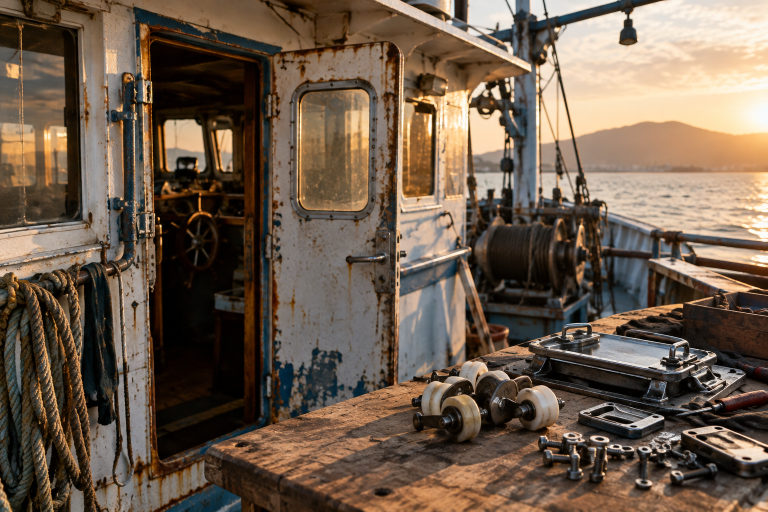
Common Replacement Parts to Source
Classic trawler projects vary widely, but difficult-to-find requests often fall into several categories.
Hardware and Exterior Fittings
- Hatch risers, hatch supports, latches, handles, seals, and related hardware.
- Pilot-house, salon, cabin, and lazarette door rollers or wheel assemblies.
- Deck fittings, hinges, cleats, access hardware, fasteners, and trim pieces.
- Portlight screens, gaskets, handles, retaining pieces, and replacement hardware.
- Cabinet catches, privacy latches, locker hardware, and interior access fittings.
Electrical and Mechanical Components
- Marine switches, lighting components, terminals, and replacement electrical hardware.
- Pumps, strainers, service parts, and related plumbing components.
- Water-heating, anchoring, windlass, and deck-equipment replacement parts.
- Seals, gaskets, handles, knobs, and small components that keep an existing system usable.
How to Identify the Correct Part
Before contacting MMI Marine, gather as much evidence as possible. An organized request saves time and makes it easier to separate critical dimensions from cosmetic details.
- Identify the vessel. Include the builder, model, approximate year, hull number if available, and the component’s location aboard the boat.
- Describe the failed item. Use plain language, such as “sliding pilot-house door roller,” “bronze deck fitting,” or “12-volt cabin-light switch.”
- Measure carefully. Record overall dimensions, mounting-hole spacing, opening size, thread size, shaft diameter, wheel diameter, or track width as appropriate.
- Take useful photographs. Include close-up images, the reverse side when accessible, and wider shots showing the surrounding installation.
- Capture markings. Logos, stamped numbers, labels, wire designations, and manufacturer names can be more useful than a general description.
- Explain the failure. Note whether the original part is leaking, corroded, cracked, missing, electrically inoperative, or difficult to operate.
Corrosion deserves special attention on exposed fittings and fasteners. Saltwater, moisture, and contact between dissimilar metals can affect both the old part and the surrounding structure, so material selection should be considered alongside fit. The U.S. Coast Guard compiles statistics on reported recreational boating accidents, which reinforces the value of systematic maintenance, even though no single replacement part can account for those incidents.
A Practical Replacement-Part Process
Start with a complete request rather than a single product name. State what the part does, where it is installed, and what outcome is required. For example, a roller may need to restore smooth operation of a heavy sliding door, while a hatch riser may need to match a specific opening and sealing arrangement.
Next, review possible matches against the original measurements and installation conditions. Confirm the required quantity, whether matching parts are needed for both sides of an assembly, and whether the repair requires companion items such as fasteners, seals, gaskets, backing plates, or electrical connectors. Before installation, verify the final fit and follow the manufacturer’s instructions for sealants, wiring, torque, and maintenance.
Why Vessel Context Matters More Than a Generic Search
A broad online search can be useful for common products, but it often returns parts that share a shape without sharing the dimensions or specifications needed for the boat. A local hardware store may be useful for basic fasteners, but it may not stock marine-specific fittings or parts suited to a legacy installation.
Providing MMI Marine with vessel context creates a more disciplined path. The request can account for the trawler’s age, the original component’s dimensions, the operating environment, and the need to preserve an existing installation. Owners still need to verify the final application, but better documentation improves the quality of the search.
Frequently Asked Questions
Can MMI Marine help with a missing hatch riser or door roller?
Yes, provided the request includes clear photographs, measurements, mounting details, and vessel information. Those details are particularly important for hatch and sliding-door hardware because similar-looking parts may use different dimensions.
What information is most important for an electrical replacement?
Provide voltage, terminal type, wire markings, current requirements when known, switch function, panel cutout dimensions, and photos of the front and back of the original component.
Why should I avoid ordering solely by appearance?
Appearance does not confirm fit, load rating, material compatibility, thread size, sealing arrangement, or electrical suitability. A careful comparison helps avoid extra drilling, unsafe wiring changes, leaks, or an unusable installation.
Conclusion
Finding one small replacement part can be one of the most demanding jobs on a classic Taiwan trawler. With accurate measurements, useful photos, vessel details, and a clear description of the problem, MMI Marine can provide a more focused starting point for locating the hardware, fitting, switch, roller, hatch component, or related marine part needed to keep the vessel working as intended.