
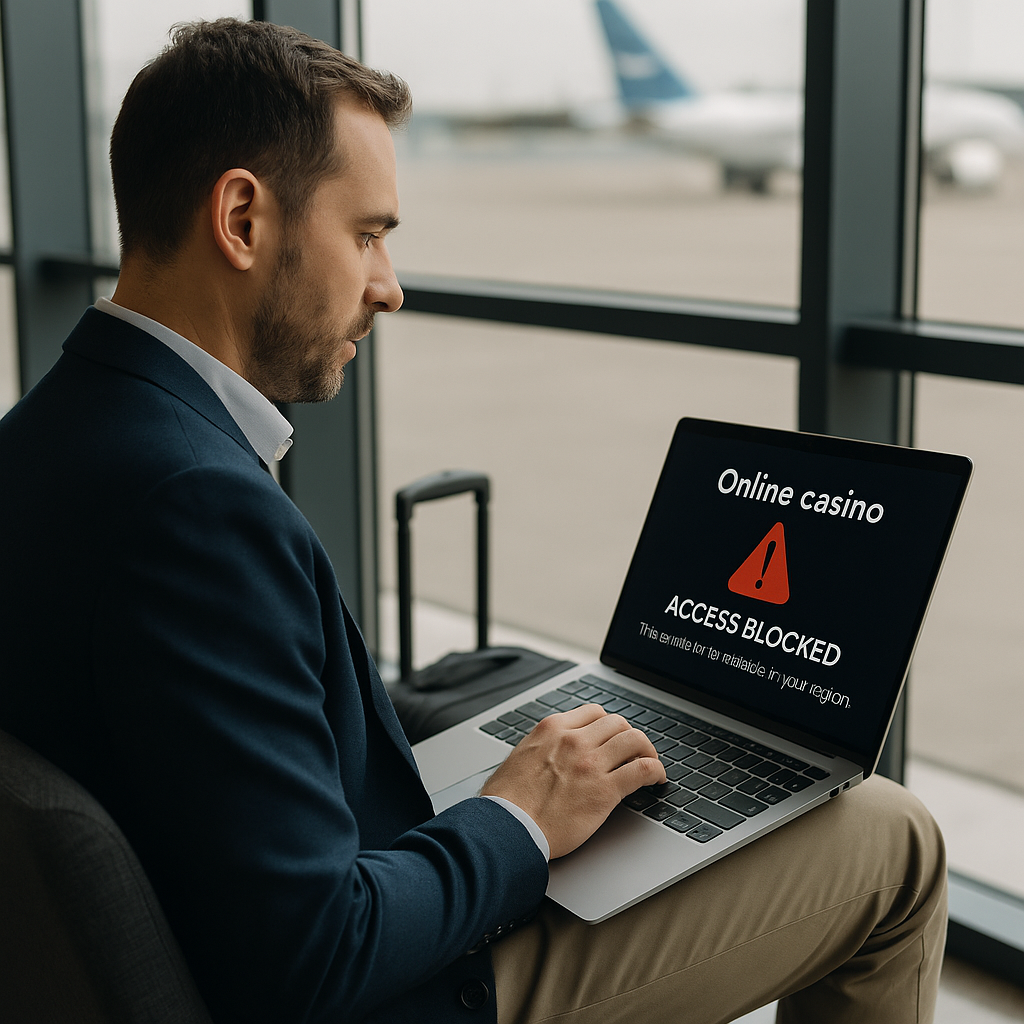
Your account works fine at home. You log in, deposit, play a few rounds, and withdraw without issue. Then you board a flight to Portugal or Thailand, open the same app from your hotel room, and the screen goes blank. A message appears: “This service is not available in your region.”
This happens to thousands of players every year. The casino did not disappear. Your account still exists. But the platform detected your new location and shut the door.
Online gambling operates under a patchwork of national laws, licensing agreements, and enforcement mechanisms. A casino licensed in Malta cannot legally serve a player sitting in a country where online gambling is prohibited. The technology used to enforce these restrictions has become more precise, and operators face heavy fines if they fail to block users in restricted areas.
So, can you still access your favorite platform from abroad? The short answer is: it depends on where you go, which casino you use, and how strictly that operator enforces geographic limits.
How Casinos Know Where You Are
Geo-blocking is the standard tool. The system reads your IP address, checks it against lists of permitted or prohibited countries, and grants or denies access accordingly. This process happens in seconds.
IP tracking is no longer the only method. Casinos now combine multiple detection layers. Device fingerprinting identifies your hardware. GPS data from mobile devices can pinpoint your location with precision. Payment-region checks flag transactions that originate from banks or cards registered in restricted territories.
If the system detects a problem, several outcomes may follow. The platform might remove certain games from view. It may block deposits entirely. In some cases, players lose access to their accounts until they return to a permitted region.
Platform Types That Work Across Borders
Some gambling sites operate under legal models that function differently from traditional online casinos. Playing at a sweepstakes casino, for example, uses virtual currency and prize-redemption systems that often fall outside standard gambling regulations. Social casinos and free-to-play platforms similarly avoid geo-restrictions because no real-money wagering occurs at the point of play.
These alternatives may remain accessible in locations where licensed casinos block users altogether. Travelers should still review local laws before accessing any gambling-adjacent platform, as some countries restrict even non-wagering gaming sites.
Countries With Strict Prohibitions
Certain destinations leave little room for interpretation. In the United Arab Emirates, gambling of any kind carries severe penalties, including fines and imprisonment. Qatar prohibits all forms of betting under national law. Saudi Arabia enforces Sharia law, which bans gambling outright. Brunei outlawed all gambling under the Common Gaming Houses Act, and its 2014 adoption of Sharia law reinforced those rules.
China permits the state lottery but bans all other forms of betting. In April and November 2024, Chinese authorities repatriated more than 1,200 nationals from Cambodia allegedly linked to gambling-related crimes. Thailand prohibits gambling due to religious and legal frameworks. Kosovo remains one of the few European countries where gambling is fully illegal. Most Islamic theocracies treat gambling as a criminal offense.
Indonesia, Iran, and North Korea also enforce complete bans. According to Gamblinglaws.org, these countries show no indication of relaxing restrictions.
How Licensing Limits Your Options
A gambling license grants a casino permission to operate in specific markets. The UK Gambling Commission, for example, requires any company offering services to British residents to hold a valid remote license, regardless of where the operator is based.
The UK gambling sector processes roughly £14 billion in annual spending. Regulations introduced in February 2024 set maximum stake limits for online slots at £5 per spin, or £2 for players aged 18–24. Since August 2024, remote operators must conduct financial vulnerability checks once players exceed defined deposit thresholds within a rolling 30-day period.
Malta Gaming Authority licenses remain common among European-facing casinos. The MGA issued 35 warnings and 25 penalties in 2024, totaling €306,250 in fines. Online gambling now contributes more than 12% of Malta’s GDP.
When you travel from a licensed market into an unlicensed one, your casino may lose the legal ability to serve you. Blocking access allows the operator to remain compliant.
The VPN Temptation
A virtual private network masks your IP address, making it appear you are connecting from a different country. Some players assume this bypasses restrictions.
It does not.
Casinos actively detect VPN usage. Bovada, a U.S.-facing operator, explicitly forbids VPNs in its terms and conditions, categorizing their use as fraudulent activity.
The consequences can be severe. Casinos may suspend accounts during investigations lasting days or weeks. Funds remain locked during that time, and many platforms reserve the right to confiscate winnings obtained in violation of their rules. Permanent bans are common outcomes.
The Regulatory Fines Are Enormous
Casinos enforce geo-restrictions aggressively because penalties are substantial. Regulators issued $184.6 million in fines globally during 2024 alone. The Netherlands Gambling Authority collected $25.7 million, including a record €21.3 million fine against Gammix Ltd.
Between March 2024 and March 2025, European regulators issued more than €36 million in anti-money-laundering fines targeting gambling and payments companies. Operators will not risk their licenses for individual players.
What Actually Works
Some casinos offer legitimate solutions. Players can contact customer support before traveling to ask whether temporary access can be enabled. Large operators sometimes accommodate this request, depending on the destination.
Payment friction can still occur. Banks frequently flag foreign deposits and withdrawals as unusual, even when casino access remains available.
Before traveling, review the gambling laws of your destination. Current data shows 79 regulated markets, 46 unregulated markets, and 70 markets where online gambling is banned outright.
In the United States, online casino gambling is legal in six states, while Utah and Hawaii prohibit all forms of commercial gambling.
The Practical Approach
Check destination laws before departure. If gambling is banned, expect access to be blocked. If regulated, confirm your casino holds a valid local license.
Contact casino support in advance. Avoid VPNs. For extended stays, consider using a casino licensed in the country you are visiting.
The rules are strict because the risks are real. Follow them, and you protect your account and funds. Ignore them, and you may lose both.
Conclusion
Playing at your favorite online casino while traveling abroad is not guaranteed, even if your account works flawlessly at home. Geographic laws, licensing limits, and enforcement technology ultimately decide access. While some platforms allow legitimate travel accommodations and alternative models exist, attempting to bypass restrictions carries serious financial risk. The safest strategy is informed compliance: understand local rules, verify licenses, and choose legal options that protect your account and your money.
Frequently Asked Questions
- Can I use my online casino account while traveling abroad?
Sometimes. Access depends on the destination’s gambling laws and whether your casino is licensed to operate in that region.
- Is using a VPN to access online casinos safe?
No. Most casinos actively detect VPN usage, which can result in account suspension, confiscated funds, or permanent bans.
- Which countries ban online gambling entirely?
Countries such as the UAE, Saudi Arabia, China (outside the state lottery), Qatar, and Brunei enforce complete gambling prohibitions.
- What legal alternatives exist when casinos are blocked?
Sweepstakes casinos, social casinos, and locally licensed platforms may remain accessible, depending on regional regulations.