
As an executive leader in both Venezuelan livestock genetics and international agricultural equipment markets, Pablo Eduardo Carrillo Fernandez brings extensive experience to the subject of evaluating cattle for long term genetic performance. Through his roles with Centro Genetico Toromacho and ONCA Equipment, he has guided breeding operations that emphasize structural integrity, productive potential, and scientifically informed selection methods. His background in developing elite hybrid lines, expanding breeding programs, and implementing modern technologies provides a practical foundation for understanding what professionals identify when assessing cattle. Drawing from decades of industry involvement, he approaches genetic evaluation as a disciplined process that combines observation with data driven insight. This perspective reflects how experts interpret subtle indicators of health, productivity, and long term value when shaping future generations of herd stock.
Evaluating Cattle for Genetic Potential – What an Expert Sees
To the untrained observer, a group of cattle may look more or less the same, but seasoned cattle evaluators see a layered story about health, productivity, and long-term value. Assessing genetic potential does not involve simply deciding if an animal “looks good.” Rather, it requires observation, experience, and understanding how certain traits translate into real-world performance.
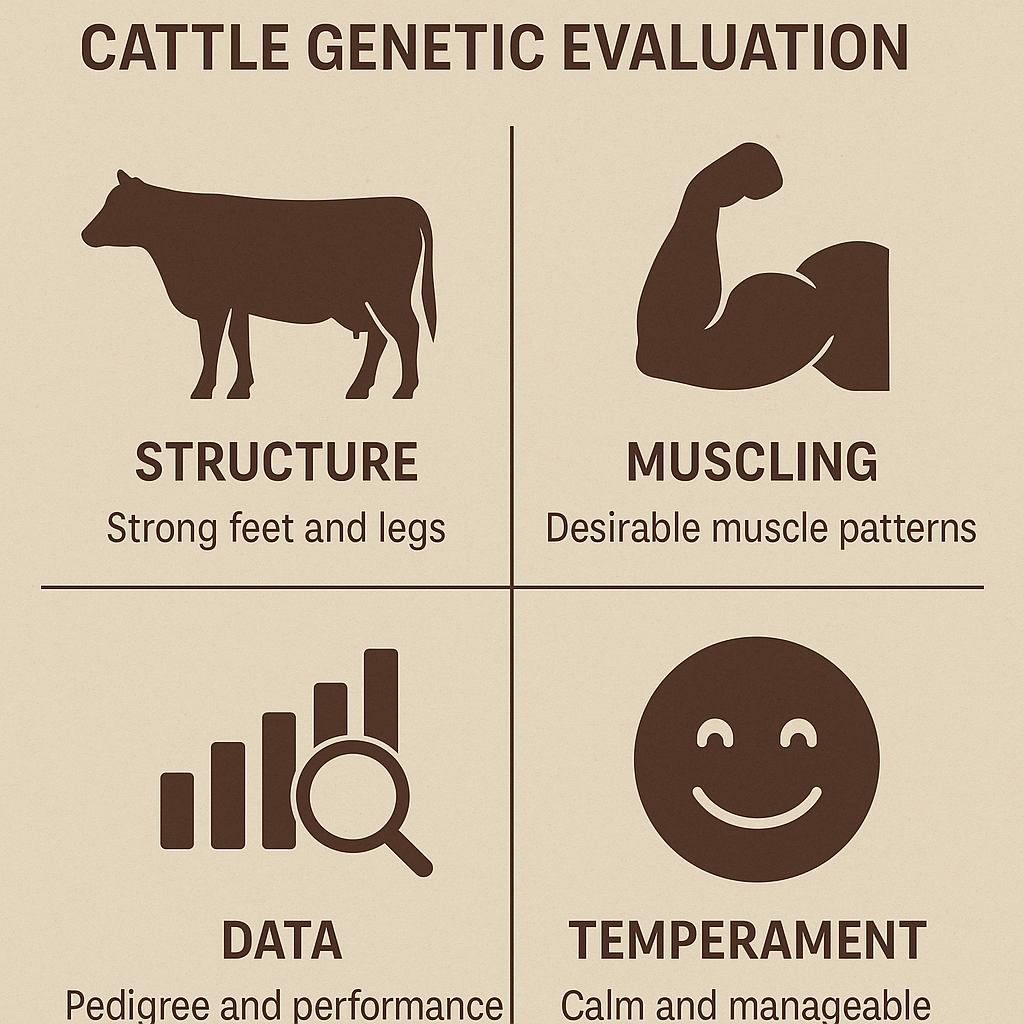
The first thing an expert notices is structural soundness. Strong feet and legs are essential because a cow that struggles to move won’t thrive, no matter how positive her other traits may be. Evaluators watch how an animal walks, noting the smoothness of its stride, the angle of its hocks, and the shape of its hooves. These details can forecast whether the animal will remain productive through many seasons or wear down early. Good structure is the foundation on which all other qualities depend.
From there, attention shifts to body capacity and overall balance. A deep heart girth, wide ribcage, and a naturally roomy frame often signal that the animal will maintain its condition efficiently and convert feed into growth or milk with less stress. Experts look for harmony rather than extremes. A bull that is overly heavy in the front or thin in the middle may face limitations that become more noticeable with age or workload. Evaluators value animals that appear well-proportioned and sturdy because those traits tend to support longevity.
While visual appraisal is important, it’s only part of the story. An expert also considers muscling patterns and how they relate to the animal’s purpose. In beef cattle, well-defined muscle across the top and through the hindquarters suggests good carcass potential. In dairy animals, the evaluator looks for angularity and openness of the ribs rather than bulk, traits tied to higher milk production. Knowing which traits matter most for a specific breed and commercial goal is essential, and experienced evaluators shift their criteria accordingly.
Of course, external appearance can’t tell everything. Evaluators frequently combine what they see with pedigree information and performance data. Birth weights, growth rates, milk records, and reproductive histories help confirm whether the animal’s physical qualities are backed by dependable genetics. Even subtle traits, like a cow’s mothering ability or a bull’s consistency in siring uniform calves, carry weight. Experts learn to connect these patterns over time, building a broader picture of genetic reliability.
Temperament also plays a role. An animal that remains calm during handling usually performs better in managed environments. Evaluators watch for signs of nervousness or aggression, understanding that behavior can be inherited just like body traits. A gentle, steady animal is safer to work with and often adapts more easily to new surroundings, making it more valuable over the long run.
Ultimately, evaluating cattle for genetic potential is a mixture of art and science. The expert eye doesn’t rely on a single feature but gathers dozens of small clues, each pointing to how the animal may perform as a parent or producer. Professional evaluators sharpen this skill through years of observation, successes, and the occasional surprise. What seems like intuition is really a deep familiarity with how form, function, and genetics come together in an animal built to last.
About Pablo Eduardo Carrillo Fernandez
Pablo Eduardo Carrillo Fernandez is the chief executive officer of Centro Genetico Toromacho in Venezuela and the founder of ONCA Equipment in Miami. His leadership includes expanding high quality breeding programs, advancing genetic technologies, and guiding international equipment and commodity operations. He has overseen the growth of multiple breeding initiatives, developed hybrid lines, and supported national efforts promoting Senepol cattle. Educated in economics at Florida International University, he continues to contribute to livestock improvement and agricultural development through strategic direction and long term industry involvement.