
Have you ever stopped to think what goes through a five-year-old’s mind when he listens to a story about a bear who misplaced his hat?
They’re building a map of the world.
It’s not a map of geography. It’s a map of who matters, what’s normal, which people are nice, and how big the world is beyond that bedroom window. And they’re constructing it with whatever books are within arm’s length.
Here’s the thing…
Books don’t magically end up there. People wrote them. People edited them. People chose to publish them. All that work — that process of traditional children’s book publishing — silently dictates what most children will ever be read before bed.
Let’s dig in.
Table of Contents
What you’ll uncover:
- Who Decides Which Stories Reach The Shelf
- Why Ten Minutes Of Reading Does So Much
- What Children Absorb Without Anyone Noticing
- The Bedtime Story Problem Nobody Talks About
- How To Get More Out Of Story Time
Who Decides Which Stories Reach The Shelf?
Here’s the part most parents never stop to think about.
The books on your child’s bedroom shelf are survivors. Editors, acquisition teams, sales reps and bookshop buyers have weighed in long before that hardback ended up on their bedside table. That’s children’s publishing in a nutshell — small groups of gatekeepers deciding, often two or three years before publication, which stories will get printed, and which will silently fade away. Curious parents who want to know who these folks are can consult a handy list of the best children’s book publishers and compare how each publishing house handles picture books, early readers, and middle grade fiction.
Why does any of that matter at bedtime?
If the industry continues to churn out the same limited stories about the same limited group of kids, that’s the world an entire generation gets handed before bed.
The good news is there are more types of books. For example, 51% of children’s titles reviewed by the Cooperative Children’s Book Center in 2024 featured significant BIPOC content. That’s the first time that number has been over 50%.
The shelf grows again. Now the real choice lies with the reader.
Why Ten Minutes Of Reading Does So Much
Ten minutes. That’s roughly what a bedtime story costs.
Yet those ten minutes are doing heavy lifting. A child listening to a story learns sentence rhythm, fresh vocabulary, cause-and-effect, and — this is the underrated part — what it feels like to be someone else for a few moments.
Studies from 2026 showed that reading picture books to toddlers enhanced their social abilities after only 14 bedtime stories. Fourteen. Seriously. Two weeks.
Here’s how it works: Stories allow children to encounter difficulties they haven’t encountered firsthand from the safety of knowing that it’s all make believe and nothing can actually harm them. A character who feels left out. A character who moves to a place where no one speaks her language. A character whose family doesn’t look like theirs at all.
Nothing bad happens to the listener. They just practise.
What Children Absorb Without Anyone Noticing
A bedtime story never says “Here’s the lesson.” That’s precisely what makes it work.
A Sense Of Other People
Ask a four-year-old how someone feels and watch something magical occur. They must leave their own head to respond.
Do that a few hundred times over a childhood and suddenly you have someone who believes other people have an inside world as well. Empathy. Empathy built one story at a time.
A Sense Of Scale
Most young children believe the world ends somewhere near the shops.
Books can expand a child’s worldview beyond what a parent may be able to do alone. Reading about life in a Lagos market or a mountain village in Peru or a small flat in Seoul is something a documentary can’t do for a five-year-old. It normalizes those places. They don’t seem exotic or “away”. Just home to other people.
A Sense Of Language For Feelings
Children can’t name what they’ve never heard.
Stories give them words — lonely, nervous, proud, homesick — way before they need them. Then suddenly they say one. And it fits.
The Bedtime Story Problem Nobody Talks About
Now for the uncomfortable bit.
Shared reading is becoming a lost art. According to research from HarperCollins and NielsenIQ, only 41% of parents with kids ages four and younger read to their children regularly. That’s down from 64% in 2012.
That’s a big drop in just over a decade.
It’s unfair too. Just 29% of nought-to-two-year-old boys were read to daily or almost daily, versus 44% of girls. Schools aren’t compensating either — the proportion of five-to-ten-year-olds hearing a class story time every day dropped to 24% in 2024.
It’s not about literacy rates. It’s who gets ten minutes of uninterrupted attention… and who doesn’t.
How To Get More Out Of Story Time
You don’t need a system. Just a few small habits that stick.
Let Them Choose
Ownership always wins. If they chose the book, they are learning.
Ask Two Questions
Pause one or two times and ask: How do you think she must feel? What would you do?
That’s it. Two questions turn listening into thinking.
Mix The Shelf Deliberately
Study the books on rotation carefully. If all your mains grew up in the same place, on the same street, with similar families then you are mapping a small world.
Add a few titles that break the pattern:
- Stories set in other countries
- Stories translated from other languages
- Stories where the family structure looks different
- Folk tales and myths from outside the usual set
Keep It Short, Keep It Regular
Quarter hour evenings trump 60 minutes once a week. Routine is key to making reading habit-forming instead of feeling like homework.
Don’t Fake The Enthusiasm
Close the book if it bores you. Kids read the reader long before they read the page. An adult having fun with the story is worth 50% of the exercise, easily.
Tying It All Together
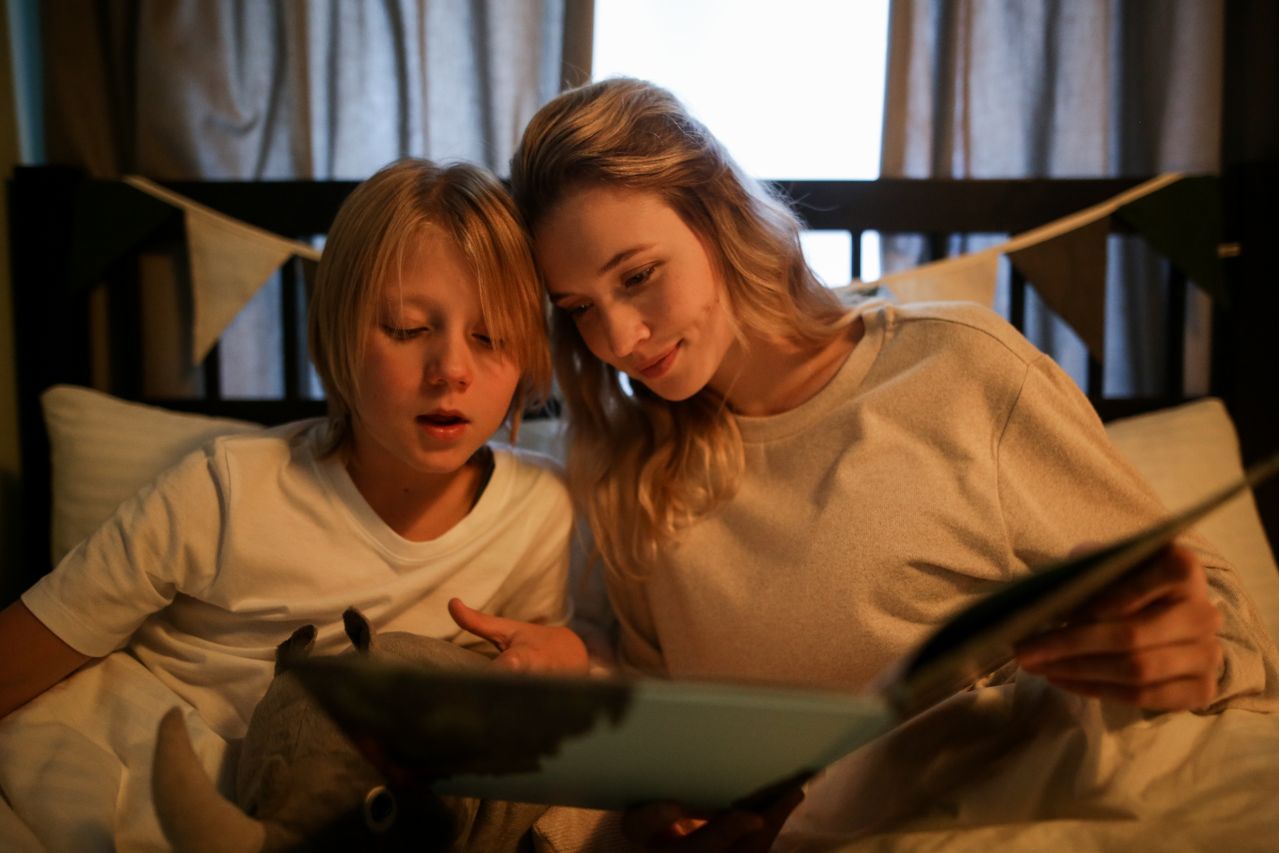
A bedtime story seems insignificant. A book, a lamp, ten minutes before bed.
However, it is one of the few times in the day where the world is brought to the child in a calm way, at their pace, with a loved one by their side.
The publishing industry itself — that gateway, that world of traditional publishing for children’s books — has gradually expanded what’s available, and that’s worth embracing. There are way more books on the shelf.
To quickly recap:
- The books available to children are chosen by an industry, not by chance
- Ten minutes a night builds vocabulary, empathy and perspective
- The habit is declining, and it’s declining unevenly
- Allow children to choose, ask a few questions
- A varied shelf builds a bigger map
Pick a book tonight. Ask one question. That’s the entire strategy.